
Tangle Rope 3D: Untie Master
Sonat GlobalCasual
4.43.74K Reviews
- Version
- 1.6.9
- Installs
- 10.00M
- Age Rating
- Everyone
Screenshots
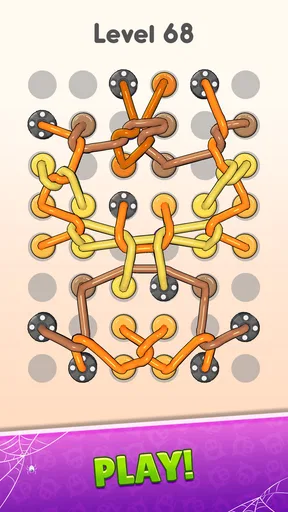
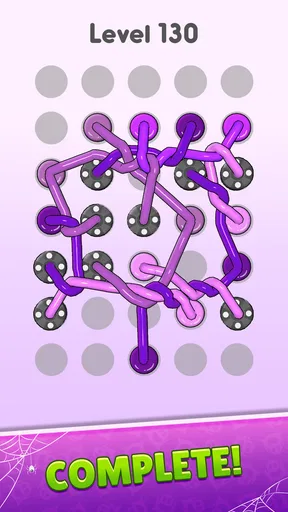
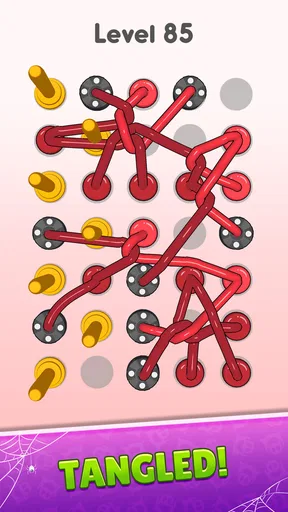
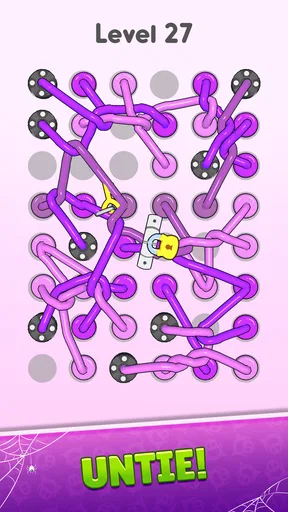
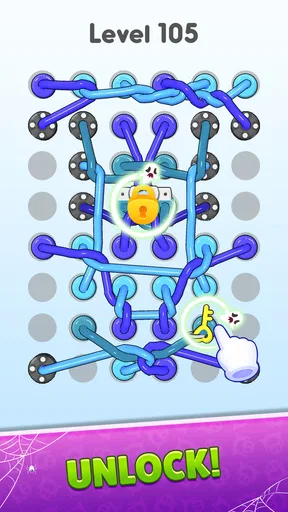
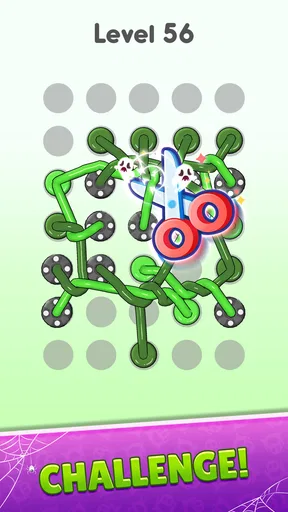
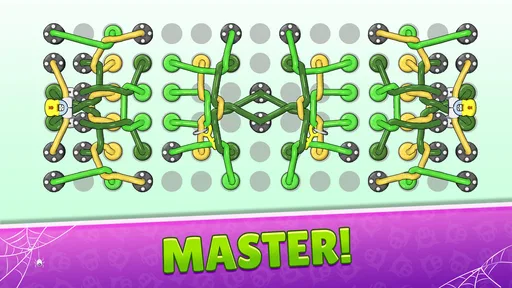
Our Review of Tangle Rope 3D: Untie Master
 Analysis by Appyee
I spent time with Tangle Rope 3D: Untie Master as a light, casual puzzle game, paying particular attention to how comfortably it can be understood and played in different everyday situations. Its central idea is easy to grasp: ropes are tangled in three-dimensional arrangements, and I need to move through the puzzle carefully until the knots are separated. That simplicity makes it approachable, but the 3D presentation also creates moments where understanding the layout takes more effort than the basic rules suggest.
Developed by Sonat Global, the game is free to start and is rated for Everyone. It has attracted more than ten million installs, with an average score of 4.4 from roughly fifty-seven thousand ratings. Those numbers suggest that its short, tactile puzzles have found a broad audience, and my experience explains why: I can open it for a few minutes, solve a problem, and put it away without learning a complicated system first.
How clearly the game communicates what to do
I focus here on how the game makes its objective understandable without a long explanation, and where that clarity starts to depend on reading the scene carefully. The useful distinction is between knowing the goal and knowing which rope to move next: the first is immediate, while the second can take patient observation. That difference helps explain why the same simple premise can feel welcoming to one player and visually demanding to another.
Readability and navigation
The strongest part of the design is the immediate objective. I do not need a long tutorial to understand that the ropes must be untangled. The visual arrangement does most of the explaining, which is useful for players who prefer learning by looking and trying rather than reading instructions. The casual format also helps when I am introducing the game to someone who does not usually play puzzle titles.
That clarity is not perfect once several ropes overlap. A rope that looks free from one angle may still be caught around another section, so I have to inspect the whole shape rather than rely on the first visible opening. This is where the 3D format becomes both the game’s identity and its main readability challenge. The puzzle is not merely about spotting a matching color or choosing a correct button; it asks me to understand depth, crossings, and order.
I found it helpful to pause before making a move. Instead of dragging the most obvious rope immediately, I look for the strand that appears to block the largest number of others. This creates a more deliberate workflow and reduces random movements. It is a small but valuable habit for new players, especially anyone who finds busy visual scenes tiring.
The navigation is simple enough for a quick session. There is no large rulebook or complicated character system competing for attention. That makes the game a better fit than many casual alternatives for someone who wants one focused activity. On the other hand, players expecting a map, story, or a wide variety of modes may find the presentation narrow. The appeal comes from repeating the untangling task with changing arrangements, not from exploring a large world.
For younger players, the Everyone rating and straightforward premise make the game easy to approach with supervision or independently, depending on the child. I would still expect some guidance at the beginning if the child has difficulty interpreting overlapping objects in depth. The rules are simple; the visual reasoning is the part that may need explanation.
Motor and sensory considerations
The main physical demand is touch interaction. I need to select or move rope elements with enough accuracy to communicate which strand I mean, particularly when several pieces sit close together. Players with limited fine-motor control may find small or crowded targets frustrating, because a near miss can feel like a mistake in reasoning even when the intended move was correct.
A practical approach is to use slower, more controlled movements rather than quick swipes. I also recommend playing with the device held steadily on a table when possible. That is not a special setting or an accessibility feature; it is simply a way to reduce accidental movement while examining the puzzle. In a bus or while walking, the same interaction becomes harder because both the screen and the player’s hand are moving.
The visual style is central to the experience, so players sensitive to crowded shapes or strong visual motion should test a short session and see how it feels. A knot can become visually dense when ropes cross repeatedly. I would not describe the game as visually demanding in the same way as an action title, but it can still require sustained concentration because the eye must follow a strand through a layered scene.
Sound is not the reason to play this game. I can focus on the visual puzzle itself, which makes it suitable for quiet environments and for people who prefer not to depend on audio cues. That also means the game’s communication is primarily visual. Anyone who needs strong spoken guidance or audio-based confirmation may find the experience less accommodating than a puzzle designed around narration or explicit text instructions.
The game’s slower puzzle rhythm is an advantage for players who dislike rapid reactions. I am generally given time to inspect a knot and decide what to do, rather than being pushed by a countdown or an opponent. This makes it more comfortable than fast matching games for a relaxed session. It does not remove all pressure, though: repeated failed attempts can become mentally tiring when the scene is difficult to parse.
Situational access in everyday play
I can imagine using this game in several ordinary situations. During a short wait at a clinic or before a meeting, one puzzle provides a contained activity without requiring a long commitment. At home, it works well as a wind-down game because the objective is repetitive and self-contained. It is also easy to hand to a friend who wants to try something immediately, since the basic task can be demonstrated in seconds.
Its free entry point matters in those situations. I can install it and decide whether the interaction suits me before spending anything. The game includes optional purchases ranging from less than a dollar to almost one hundred dollars per item, so I would treat the free experience as a trial and check every purchase prompt carefully. A child using the device should have the usual purchase restrictions in place, especially because a simple casual game can encourage quick taps when someone is eager to continue.
The current version is 1.6.9, and it supports devices running Android 7.0 or later. That makes it relevant to people who keep an older Android phone rather than upgrading frequently. Still, compatibility alone does not guarantee a comfortable experience: screen size, touch responsiveness, and the condition of the device can affect how easily I distinguish and select ropes.
For travel, the game has a useful stop-and-start quality. I do not need to remember a story or coordinate with other people. However, a small screen can make overlapping strands harder to follow, and glare outdoors can reduce the contrast between parts of the puzzle. In a dim room, the opposite problem may appear: a bright display can become uncomfortable during a long session. Adjusting the phone’s general brightness is therefore more useful than trying to force a long play period in unsuitable lighting.
It also suits shared play in a limited way. Two people can look at the same puzzle and discuss which rope should move first, making it a pleasant low-pressure activity for a parent and child or two friends. It is not a true cooperative game, though. The interaction remains centered on one person controlling the device, so it may not satisfy players looking for equal participation or multiplayer communication.
What makes the 3D format useful, and what it costs
Compared with ordinary two-dimensional matching games, this one asks for a different kind of attention. In a typical match-three title, I often scan for patterns and make fast selections. Here, I trace relationships: which strand passes over another, which section is trapped, and which move will open space for later decisions. That gives the game more physical character than a flat tile puzzle and makes successful solutions feel earned.
The trade-off is that the same depth can obscure the answer. A player who enjoys spatial reasoning may see the crossings as the fun part, while someone who prefers clear symbols and predictable grids may experience them as visual clutter. I would choose this game over a standard matching title when I want a slower inspection puzzle. I would choose the matching game instead when I am tired, using a small screen, or looking for instant recognition rather than careful tracing.
It also differs from classic logic puzzles on paper. A paper puzzle usually lets me mark possibilities, erase them, and keep a visible record of my reasoning. Here, the solution depends more directly on touch and on interpreting a rendered object. That makes it more playful and tactile, but less suitable for someone who wants to annotate every step or solve through written deduction.
One useful technique is to solve from the outside inward. I first examine loose ends and exposed sections, then consider the central crossings only after removing the obvious obstructions. This is not a separate feature; it is a way of reducing visual overload. Another is to avoid repeatedly testing the same rope from the same angle. If the arrangement remains confusing, I change my viewing position or inspect a different strand rather than making identical guesses.
Remaining barriers and where the game may disappoint
The biggest barrier is the lack of guaranteed clarity in a crowded knot. Even when the rules are understood, the player may not immediately know which object is selectable or how a movement will affect the rest of the arrangement. This can be especially difficult for people with reduced visual acuity, depth-perception challenges, or motor limitations that make precise touch selection uncomfortable.
I would also be cautious about recommending it to someone who needs extensive customization. The core experience is built around seeing the ropes and manipulating them directly, so it cannot easily be separated from visual-spatial interpretation. Players who require large controls, strong text alternatives, spoken instructions, or highly adjustable contrast should consider whether the game’s presentation gives them enough support before committing to longer sessions.
Another limitation is repetition. The concept is focused, and that is part of its charm, but it can also narrow the audience. If I want narrative progress, character development, competitive rankings, or a broad collection of puzzle rules, this is unlikely to replace a larger puzzle suite. The game is best understood as a dedicated untangling activity rather than an all-purpose casual collection.
In-app purchases are another point to handle thoughtfully. Free access lowers the barrier to trying the game, while the wide purchase range means families should manage the device’s payment settings rather than assume every continuation is cost-free. I would not let a child play unsupervised on a device with unrestricted purchasing. That is a practical household consideration, not a criticism of the rope puzzles themselves.
Players who become frustrated by trial and error may also want to set a short session limit. I sometimes get too focused on a stubborn arrangement and start making moves without properly reading the shape. Taking a break is more effective than repeatedly tapping at the same crossing. The game rewards patience, but it does not necessarily teach patience explicitly, so the player has to create that rhythm.
Who should try it
I recommend it to people who enjoy compact spatial puzzles, tactile problem solving, and games that can be played in brief bursts. It is a particularly good choice for someone who wants more thought than a basic matching game but less commitment than a story-driven adventure. The free starting point makes it easy to test, and the Everyone rating broadens its use for families, provided adults handle purchase controls responsibly.
I would be more selective for players with limited fine-motor control or visual processing difficulties. That does not mean they cannot enjoy it; it means the direct rope manipulation and overlapping 3D shapes should be tested personally. A larger display, steady surface, good lighting, and slower movements can make the experience more manageable, but those adjustments cannot change the underlying design.
I would skip it if my main goal were social play, deep narrative, or a large range of puzzle mechanics. I would also look elsewhere if I needed extensive accessibility settings to adapt the interface. A flat, grid-based puzzle may be a better option for someone who finds depth and overlapping strands tiring, while a spoken or text-led puzzle may be preferable for someone who cannot rely comfortably on visual inspection.
My inclusive verdict after playing
My overall impression is that Tangle Rope 3D: Untie Master is welcoming at the rule level but more demanding at the perception and touch level. Anyone can understand the goal quickly, and the relaxed pace avoids the reaction pressure found in many casual games. The challenge appears when the ropes overlap, because success depends on following a three-dimensional object accurately and selecting it with care.
That distinction is important. The game is not inaccessible simply because it uses 3D puzzles, and it is not automatically accessible simply because it is casual. Its strengths are the clear premise, short sessions, free entry, and thoughtful spatial challenge. Its weaknesses are crowded visuals, direct touch dependence, limited variety, and the need to manage optional purchases responsibly.
After trying different ways to approach the knots, I found the best experience came from treating each puzzle like a small inspection task: steady the device, identify the least obstructed strand, move slowly, and pause when the layout becomes confusing. That workflow makes the game less about frantic tapping and more about controlled observation. It also gives players with different comfort levels a fairer chance to decide whether the interaction works for them.
Sonat Global has made a focused casual game rather than a broad accessibility-first platform, but the focused design has real value. I can recommend it to a friend who likes untangling objects, wants a quiet mobile distraction, and is comfortable with visual touch puzzles. I would explain the 3D crossings and purchase range before recommending it to a family or to anyone with specific access needs. For the right player, it is an easy game to start and a surprisingly absorbing one to solve; for others, a simpler flat puzzle will be the kinder choice.
Verdict
Strengths of Tangle Rope 3D: Untie Master
- Simple controls make it easy to start playing immediately.,3D rope puzzles offer a satisfying visual untangling experience.
- Short levels are convenient for quick gaming sessions.
- Gradual challenges help introduce the puzzle mechanics naturally.
- Offline play makes it suitable for gaming without an internet connection.
Limitations of Tangle Rope 3D: Untie Master
- Later puzzles can feel repetitive after extended play.
- Some levels rely more on trial and error than strategic planning.
- Ads may interrupt the experience between puzzle attempts.
- The difficulty curve is not always consistent across levels.
- Limited variety in objectives may reduce long-term replay value.
Other Releases by Sonat Global
View All
Hole Master - Eat The World
Casual4.1
Similar Picks in This Category
View All
My Talking Angela
Outfit7 Limited4.2

My Talking Tom
Outfit7 Limited4.3

Pou
Zakeh4.2

My Talking Tom 2: Pet Game
Outfit7 Limited4.3

Candy Crush Saga
King4.6

Bridge Race
Supersonic Studios LTD4.1
Frequently Asked Questions
What is Tangle Rope 3D: Untie Master?
Tangle Rope 3D: Untie Master is a casual puzzle game focused on untangling colorful ropes and solving increasingly complex knot arrangements. You interact with the ropes by selecting, dragging, and repositioning them to clear the tangled layout. The early stages are easy to understand, while later puzzles require careful planning, patience, and attention to the order in which ropes should be moved.
How do you play Tangle Rope 3D: Untie Master?
The main objective is to separate every tangled rope without creating additional obstacles. Tap or drag ropes to change their positions, identify which strand is blocking another, and gradually free the knots from the board. A successful solution usually depends on examining the entire arrangement before making a move. Since some levels can be solved in different ways, experimenting is an important part of the gameplay.
Is Tangle Rope 3D: Untie Master free to download and play?
Tangle Rope 3D: Untie Master is generally available as a free download, allowing players to try the core puzzle experience without paying upfront. However, free mobile games may include advertisements, optional purchases, or rewards connected to watching promotional videos. Availability of specific features can vary by device, operating system, region, and app version, so it is worth checking the store listing before downloading.
Does Tangle Rope 3D: Untie Master require an internet connection?
The basic untangling puzzles may be playable without a constant internet connection, which makes the game suitable for short sessions while traveling or when mobile data is unavailable. Nevertheless, an internet connection can be needed for advertisements, cloud-related functions, updates, event content, or optional rewards. For the most reliable experience, open the game online at least once after installation and review its current requirements.
Is Tangle Rope 3D: Untie Master suitable for children and casual players?
The game is easy to pick up because its central mechanic relies on familiar touch controls and visual problem-solving rather than complicated instructions. It can be enjoyable for casual players and older children, although the difficulty may increase as the levels progress. Parents should still check the game’s age rating, advertising content, privacy information, and in-app purchase settings before allowing younger users to play independently.
Play our best games!


